2025 Books: Reading, Learning, Thinking (235)
Books I read in 2025 and capsule reviews. Reading is good. Read more.
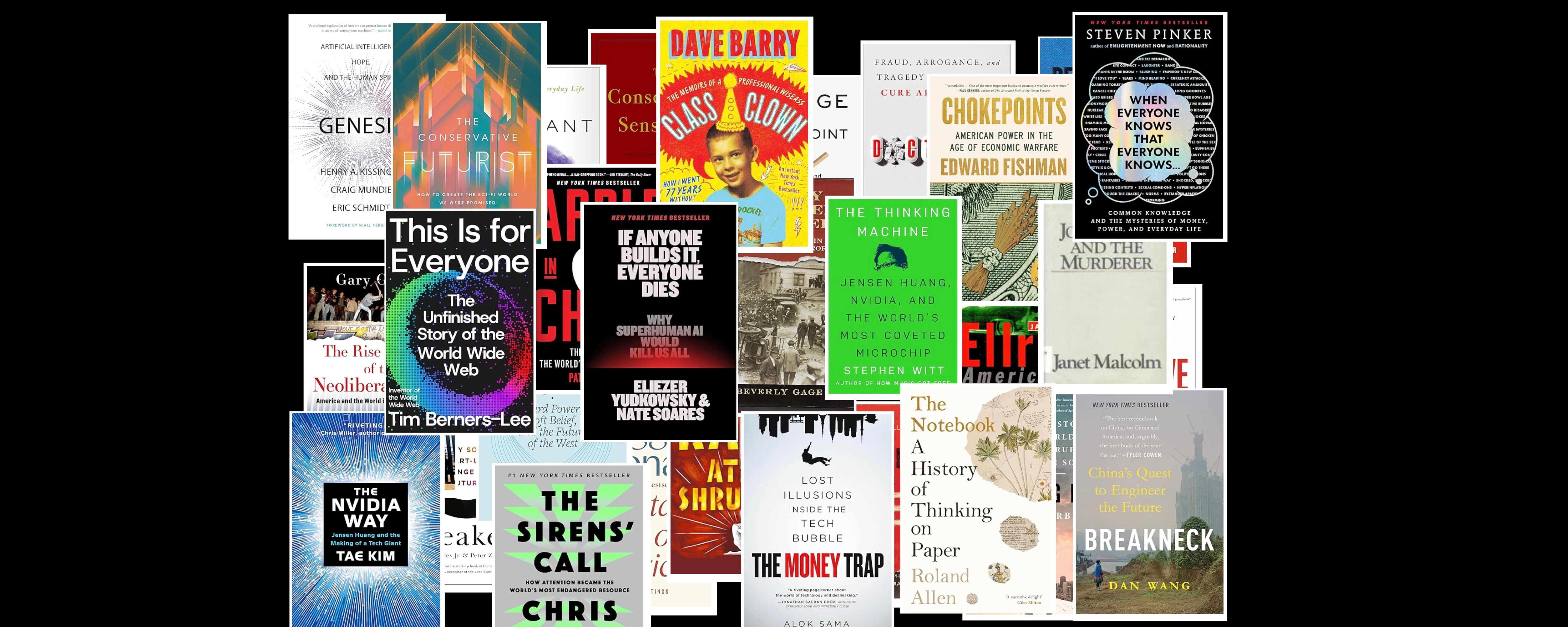
What a year it has been. It has also been a year where I chose to read books from a wide range of topics, some well outside the technology and innovation non-fiction I almost exclusively read. With books on Apple, Nvidia, China, and AI there was plenty in my traditional wheelhouse—some very good and some not so much IMO. Like many hot topics there were often multiple books from different perspectives so I was glad to find the one I might recommend to someone looking for one.
As always, these are not affiliate links so find your favorite outlet. Most every book is available in multiple formats including audio which is my favorite these days. Books presented in order I read them, most recent first.
Happy Holidays and Best Wishes for the New Year!
PS: As an author, I know the personal pain of even the slightest criticism but I am offering my honest opinions below. 🙏
1. The Notebook: A History of Thinking on Paper by Roland Allen https://a.co/d/4HhtAu1 // [no, not THAT Notebook] what a fun book. In the spirit of the Petrosky class, “The Pencil”, this book goes through the history of the notebook, sketching, and taking notes. Loved it. Great way to end the year of books. I 💯 in on paper notebooks. Book starts with a very fun and slightly snarky history of ever present and not as old as you think moleskin. For the technologist this book covers the technology of notebooks. For the intellectual it covers the psychology of note taking. It is super fun in the spirit of Petrosky books like The Pencil.
2. Nineteen Eighty-Four, Brave New World, Fahrenheit 451, The Time Machine, Animal Farm. The “big three” or four or five of dystopian fiction as often (in olden days) studied as a unit in middle school or early high school. Seems like the time is right to re-read these because so much of the 20th century is being revisited. Also, because no matter which side of the political spectrum you’re on, there’s a good chance you see dystopia in what the other side is doing or saying. There are some wonderful audio book productions of those to be enjoyed as well. Wild how much the language in these is just our language. Double plus good :)
3. When Everyone Knows That Everyone Knows . . .: Common Knowledge and the Mysteries of Money, Power, and Everyday Life by Steven Pinker https://a.co/d/fvHGzgv // how many levels of lying before something becomes common knowledge? This book asks that interesting question as it dives into the topic of common knowledge. What is common knowledge? It is stuff that I know and you know, and I know that you know, and I know that you know that I know. You will get the hang of that after about the 20th time the book repeats this phrase. For me it just made the book and the ideas difficult to wade through. There’s obviously something there, but I struggled.
4. The Money Trap: Lost Illusions Inside the Tech Bubble by Alok Sama https://a.co/d/fRu9Ny2 // Liar’s Poker meets the crazy guy. This is a memoir by Alok Sama the former chief deal maker at SoftBank. This is finance porn through and through. I lost count of how often the price, brand, size, or exclusivity of some consumable, home, or article of clothing was vividly described. Every meeting was described starting with the private jet taken to get there. The porn never ends. It also has the kind of humility you’d expect such as the tiresome criticism of Masa San for holding investments too long but then is critical—without saying who made the call—about selling Nvidia too soon. It’s an easy read but not one to learn about SoftBank or Masa. The epilog demonstrates the true nature of “crazy guy” and how it is the outlier deal that makes up for all the losses, something a “cook” (Masa’s—the hunter—description of Alok) doesn’t always appreciate. I appreciate much the honesty with which the story is told.
5. 🕸️🕸️🕸️This Is for Everyone by Tim Berners-Lee https://a.co/d/iL3IGU6 // This book is part memoir of the WWW technologies from the start, part personal memoir and victory lap, and part opining on the past and future of the connected world. In that sense it covers a lot of ground, but it also can leave you wanting more in any one of those. There’s a lot of reflection over how things turned out on the “internet” versus perhaps the original intent, or at least intent as described today. At times this reads a bit like “what hath man wrought” and regrets over the forces that took web technologies in directions different than TBL would have. Perhaps the most interesting journey in the book is one of life—going from the “hands off” view of regulation in the early days to a gradual embrace of regulation then to a need for regulation to today’s AI world which needs precautionary regulation. It reaches the peak with this statement “Course correct AI now before the exploitative use patterns of the past decade repeat—now is our chance for a do-over” contrasting sharply with the earlier statement “I’m not one to believe in regulation but…”. There’s a similar arc when it comes to the author serving as director of W3C and not wishing to employ the authority of a centralized leader of the web to the end where it is clear not only did he exercise that authority, but he seemed to view it as necessary to counteract the “forces” of the larger companies. The book spends a great deal of time on personal data and rights to privacy—views I see as the classic libertarian views of MIT and the earliest hackers in a positive way—but proposes a technical solution (Solid or data wallet) that clearly can’t work without just freezing the world in a government mandated top-down manner and even then it is unclear how this becomes a privacy win (anyone you provide your data to can, or must, store it unless you mandate all computation happens on a device but then the standard must encompass a universal cross-device runtime as well as a similar data store, the web doesn’t really do that today even if some thinks it comes close). I always struggle when someone starts from the untrue argument that the biggest social networks/search engines “sell your data” as they decidedly do not sell data (that’s their whole moat). There are a lot of moments from the past that make an appearance which makes the book fun to read for an old-timer like me: debates over formats like RDF and RSS, debates between competing web standards bodies (W3C and WHATWG), debates over minor things like colors of links or IMG tag, and more. I recommend reading it because it is important but not because it is easy to agree with. The audiobook version has a bonus interview between TBL and Stephen Fry that I think validates some of what I said above.
6. 🙀🤮 If Anyone Builds It, Everyone Dies: Why Superhuman AI Would Kill Us All by Eliezer Yudkowsky, Nate Soares https://a.co/d/4fN6CUa // #1 Best Seller on Amazon! This from the doomer of all doomers so I had to read. It is ridiculous. I want this time back. I was lost at the comparison of AI to pre-NAZI Germany and the holocaust. Someone described this to me much better than I could. This is a book about debating the fantasies of AI much like debating battles in the MCU. Anything is possible but nothing is real. Read this by Thomas Dullien instead http://addxorrol.blogspot.com/2024/07/someone-is-wrong-on-internet-agi-doom.html
7. ⭐️⭐️⭐️⭐️ Underground Empire: How America Weaponized the World Economy by Henry Farrell, Abraham Newman https://a.co/d/7SalE5E // This book makes a strong argument about liberty and why trying to control the global financial system as a political tool of economic warfare has backfired. It is most relevant to the USD reserve currency concerns many have. My view is this book pairs nicely with Chokepoint below which tries (and IMO fails) to make the case for economic warfare. I really liked this book even though it is critical of some people/ideas I agree with. Loved the discussion about Microsoft and how tried to be clever only to find itself “unknowingly” complicit in this surveillance and ultimately came to define itself as an arm of the government like banks. The book explains broadly the incredible dilemma large multinationals face when operating under the threat of regulatory retaliation for not doing what is illegal for the US government to do on its own.
8. 🇺🇸🇨🇳🦫⚖️Breakneck: China’s Quest to Engineer the Future by Dan Wang https://a.co/d/9WBG0Iu // This is a wildly popular book about the current economic competition between China and the US/West. I really love the framing of “engineer v lawyer” that permeates the book. Dan goes through the specifics of this framing, the difference in “building” (a favorite tech topic), the rise of technology in China (see Apple in China below), and decidedly draconian policy failures in China on Covid and one-child. The final chapter of the book is a call for a “best of both worlds” for the US to embrace engineering more Dan and I did a podcast on the book which is on the a16z site.
9. 👍The Journalist and the Murderer by Janet Malcolm https://a.co/d/24QVrbw // a favorite of my friend @balajis is from a decade ago and was ahead of its time for many. The begins by describing the pain one feels after cooperating with a journalist who comes to you and says they want to tell your story, but when the story releases it is anything but. Until you’ve felt this pain, anger, humiliation, betrayal or worse it is tough to really say what it feels like. Whether a story about you, a person you know, events you witnessed, or events you participated in, the feeling is unique. You can be triggered for years after and with the internet these stories are amplified repeatedly, never to be filed away. It truly does suck. But why is that? This book explores the whole process of journalism and the mindset required, even when it hides behind “accountability”, “truth to power”, or “first amendment” and the inherent conflict when the journalist claims to learn along the way and changes sides in a story. This is all told through a real-life story of a journalist writing about a murder.
10. 🫤 The Sirens’ Call: How Attention Became the World’s Most Endangered Resource by Chris Hayes https://a.co/d/fAkCNM9 // This is a book about attention. It didn’t capture mine because it was too “pop psychology” and relied on what I think of as relatively shallow non-primary sources we see in media, advertising, etc.
11. 🌴🤡😹😹😹Class Clown: The Memoirs of a Professional Wiseass: How I Went 77 Years Without Growing Up by Dave Barry https://a.co/d/daVZgbe // Dave Barry holds a special place in my heart because when I was in high school he started writing for the Miami Herald and quickly it showed up in the Orlando paper and my best friend was immediately tuned into it. His books were the kind we read on the plane or bus on trips and loved them. The humor—reflecting our most decidedly that back of the classroom smart ass mocking everyone and everything that was so 80s—made us feel more grown up than we were and I think only later did we understand the layers of meaning and seriousness of his work. This was an enjoyable memoir and of course an amazing read. Hilarious description of his first real job as a business writer coach. Amazing stories of that crazy era of journalism where one could get paid 3x the salary of an engineer and have an unlimited expense account to write one column a week. Wild times even he admits. The audio book is a treat because Barry narrates. I listed while morning walking and laughed out loud with almost every sentence.
12. 👎🚫The Thinking Machine: Jensen Huang, Nvidia, and the World’s Most Coveted Microchip by Stephen Witt https://a.co/d/95I6W84 // I knew this book would be less satisfying than Nvidia Way from the introduction where the author described “prominent AI researchers wrote an open letter about the risks and dangers of AI…and Huang did not sign it.” Even the title “most coveted chip” is meant to sound less than positive (envy doesn’t invoke positivity). Then after the 4th time of recounting the stock price, the cost of clothes, or enumerating the compensation of named executives I began to lose patience. What followed were some choice insights such as “… All of this innovation will go through a single corporate siphon”—corporate siphon??? Then “ the largest single day gain of any stock in Wall Street history. Most of that was due not to what Nvidia had done, but what investors expect it to do in the future.” Pure. Genius. Then finally the book concludes with what amounts to an Atlantic essay on AI doomerism that has nothing to do with Nvidia other than the writer was fortunate enough to be able to ask dumb questions of Jensen. Do not waste your time with this book. Tae Kim’s book is useful. Reading this book will make you dumber about AI, Nvidia, and innovation. Truly cringe. <<Insert Billy Madison meme>> I’m sad that Jensen got interviewed for this book since it lent it credibility it did not deserve.
13. 🚀🚀🚀The Nvidia Way: Jensen Huang and the Making of a Tech Giant by Tae Kim https://a.co/d/aRJRNHv // just read this. There aren’t any good books on Nvidia and Jensen history and this one is very well done and current. I appreciate a book about a tech company that looks critically but not cynically or fatally. Go read this. Jensen is a legend and he’s not done by any stretch. Love the hat tip to “The HP Way”. The book is very accurate in terms of how it describes the technology. There’s one section “the engineer’s mind” that I don’t agree with but it’s a cliché and so it’s not a surprise to see it. If you’re a lover of culture, then this book is definitely for you. It also arrives for a technical level not often seen which I liked especially with respect to CUDA which is not discussed enough elsewhere. Wish it would have talked about ARM a bit more. Maybe that is the old battle though.
14. Chokepoints: American Power in the Age of Economic Warfare by Edward Fishman https://a.co/d/bEZthjO // this appears to be straightforward book that details the history of going to war not with rockets but with banking, trade, and reserve currency, but it is very much a sided political book by a participant. Depending on your perspective on any given issue, this book details a brilliant strategy or the way the government tells the private sector what to do without the actual legal right to do so. It tells the story of protecting the nation while perhaps chiseling away at the rights of all in a free society and harming innocent civilians far more than the government or military to achieve dubious ends. The book is told by an expert who served in the Obama administration in a sanctions capacity at State, though it is written as a third person account. It is not a particularly advanced or technically detailed work, but it provides a breadth overview of the complex world of financial regulations, sanctions, and statecraft. I found this book to be far too much of a success story for economic warfare (as it was called) especially as practiced by Obama/Biden. There’s so little sustained evidence that sanctions work with the most common examples being South Africa and Iran and arguably drug cartels, all of which ultimately remain disasters. Even the book praises the nuanced and multilateral approaches Obama took on the heels of the Russian invasion of Crimea which by some views set in motion the invasion of the rest of Ukraine a few years later where apparently those Biden sanctions were also successful. The conclusion was sanctions work but Obama was just too brilliantly collaborative and thoughtfully nuanced in approach. Then China, mostly Trump actions, were described as mostly erratic and ineffective which should be evidence of how sanctions don’t work but it was not. Most of all the challenge I have with claiming that economic warfare is effective is that the only victims in this kind of war are civilians and private companies. The government doesn’t suffer. Putin did not lose anything nor did his oligarchs, but everyday Americans, Russians, and Europeans suffer. Yet many of the “boycott divest sanction” advocates are often quick to call out civilian casualties in kinetic wars. And with China seen as a viable reserve currency sanctions simply punish the dollar, yen, and euro. As far as effectiveness see also https://web.stanford.edu/class/ips216/Readings/pape_97%20(jstor).pdf. I appreciate the realty of limited tools and real war is a horrible option, but without a grand reset of the global economy, economic warfare is overwhelmingly civilian casualties and has a limited to no track record of even medium-term success. I don’t think enough attention in the book was paid to the price we all pay in losses of freedoms and privacy in our own financial lives that economic warfare as a tool have introduced.
15. 🚀🚀🚀Gambling Man: The Secret Story of the World’s Greatest Disruptor, Masayoshi Son by Lionel Barber https://a.co/d/4JCHvt6 // I loved this book because Masa Son is one of the greats of the internet age. Most know him probably from his recent and somewhat mercurial investments like WeWork, but he has an incredibly long and wildly successful (with high highs and low lows) investing in the internet. Just read this. It’s great. To be fair this is not a glowing biography by any stretch and I know fans will not take to the negatives, and I have quibbles with some of the pettier descriptions. I view this book as capturing a lot of detail about a “crazy guy” that I and many admire. The most recent ARM deal was incredible.
16. 🤔 Blind Spots: When Medicine Gets It Wrong, and What It Means for Our Health by Marty Makary https://a.co/d/15kHhR8 // Dr Makary was recently appointed to lead the FDA. This book takes on several scenarios where the conventional wisdom from physicians turned out to be wrong: from poor research to falsehoods to the human condition. It is an interesting book, and it is easy to get drawn into it. That said, it seems where in a moment where institutional trust is at a new low but at the same time simply trusting those that lead the way in showing the circumstances that got us here isn’t right either. I found quite a few places in this book where the evidence to counter the bad science were equally bad and that was disappointing. This isn’t the scientific reference it should be. In the end the book seems to be a list of “conventional wisdom that is wrong” which is super painful to see but unclear what the answer to this is, especially when there is no way to make only evidence-based decisions in medicine. Ultimately in medicine not everything has a study or data, in general, or in the case of a specific set of patient conditions. Read with caution. Medicine has a lot of issues, but this doesn’t show that trusting those who found them to be more trustworthy.
17. ⭐️⭐️⭐️⭐️ The Conservative Futurist: How to Create the Sci-Fi World We Were Promised by James Pethokoukis https://a.co/d/aOONws8 // I really found this book a useful read. It is a great answer to both the “Abundance” book and “we wanted flying cars”. Whereas “Abundance” is more of an apology for not building things plus a reworking of a traditional agenda, I find this book to be a more sincere view of the cycles of the economy and in particular the damage that the post 1970-1995 public opinion and policy shifts caused and why a return (hence conservative versus a “right wing”) approach is needed. This book speaks to the great forces that have been at work that pushed the economy forward and the idea that growth is not bad and in fact is necessary. Super bonus points for references (lots) to Star Trek and Expanse.
18. 🔥The Day Wall Street Exploded: A Story of America in Its First Age of Terror by Beverly Gage (2018) https://a.co/d/9Q7ZtDt // I literally had no idea that a dramatic series of bombings—dynamite terrorism—were perpetrated in NYC against the financial centers in the early 20th century championing anarchy, socialism, and labor. All before 9/11 or the 1993 WTC bombing (both by what we think of as classical terrorism). This early domestic violence was really the start of a century of socialist or “left wing” violence in the US that received a ton of attention in the late 1960s and early 1970s (Weather Underground bombings, the urban violence across the country — think of films like Dirty Harry and Death Wish). The long trail of socialist and anti-capitalist deadly violence is really something, but more than that is the growth in the defense that the violence was justified on higher moral grounds. That brings us right up to Luigi and then Molotov cocktail attack against Jews that happened as I was reading this. This was another book about history that reminded me of all that I don’t know. The contrast between coverage of this violence/the memory hole of the turn of the century and the wall-to-wall coverage of “white nationalist violence” or “domestic right-wing terrorism” is quite stark.
19. Apple in China: The Capture of the World’s Greatest Company by Patrick McGee https://a.co/d/fiZlQ1Z // This is a book that details the level to which Apple has invested in China. My sense is (aka guess) the book was initially going to be mostly anti-Apple/exploitation of cheap labor, but since the recent election the narrative on China has dramatically shifted to what was previously a narrowly held view of state enemy #1. As such the book is both negative on Apple and China, painting Apple as an enabler of the “rise of China”. It is important to keep in mind that in the US each political party has held a minority view of China as enemy since Nixon opened relations. Back then and through Reagan even China was a military enemy but an economic opportunity to some and a trade enemy and fragile communist state that would flip to democracy to others. Under Clinton parties began to switch as the majority of democrats embraced the WTO and free trade while republicans became more skeptical of free trade. Democrats became focused on human rights while republicans focused much more on totalitarian enemy and much more protective of trade/jobs. The one constant view has been the subset of republicans who have thought of China as a military enemy and risk to economic security/jobs. This appears to many now to be a new consensus view replacing the free trade will beget democracy in China. Thus, you cannot read this book in only today’s political context. While I decided to read this because I is an important topic, to say Apple either because of its scale or visibility is somehow a culprit in whatever is going on ignore the trillions of dollars that flow to China from the rest of the world every year. It downplays the foundations of the tech industry that were in China/Taiwan already when Tim shifted Apple to China from the US, not to mention the “low tech” manufacturing that was outsourced to China already. I get the symbolism and the narrative desire to paint this as Apple and specifically Tim. But wanted to say that up front. We spun up a whole assembly effort in China for Microsoft Surface. The introduction and history of Apple is well told and worth it just to remind everyone of what went on from 1975-2000.this is primarily a connect the dots narrative including many selected quotes from Apple analysts who were wrong as often as they were right. Apple did this then that happened. Govt of China does that then Apple did something. It pains a very tight picture of a narrative of Apple getting played or willingly sacrificing much to gain and maintain its huge China business. My sense and experience don’t really support so much “evil” on either side. I think both sides were doing what they believed genuinely right and still didn’t have a clear multistep plan. The book mentions the changes is cars including the early success of VW, then Tesla, and rise of BYD. Many industries were like that. Many others were not. Chinese consumer electronics for example have not really achieved global status (though some due to trade barriers) for example TCL tv or Haier home appliances or software in general. This is one of the most important business and geopolitical issues of our time. Reading this book should name make you angry or partisan but should point out just how insanely complex what Apple did was and how wrong all the US experts were about China (I would out myself in there wrt to software). One of my pet peeves is when people portray China as corrupt or the Chinese government as heavy handed without considering that international (or domestic) companies in the US face these same issues just expressed differently. I haven’t written much about when I lived in China, but this post is recent as if this book.
231. When It Comes to Tariffs, China is Different
Much has been said about how the U.S. benefits from China’s manufacturing strengths, and tariffs often dominate the debate around international trade. But what’s often overlooked is how incredibly difficult it is for American companies to sell into China and to build a sustainable business—particularly when it comes to services and intellectual property…
20. The Elephant in the Brain: Hidden Motives in Everyday Life by Kevin Simler, Robin Hanson https://a.co/d/9huCau6 // This is a social science book that brings together several lessons, observations, and anecdotes about how we lie to ourselves. “The aim of this book, then, is to confront our hidden motives directly - to track down the darker, unexamined corners of our psyches and blast them with floodlights.” It all makes sense. It is important to know this is happening even when you’re certain you are being objective. It especially resonates if you write or tell stories about situations that you were a participant.
21. The Rise and Fall of the Neoliberal Order: America and the World in the Free Market Era by Gary Gerstle https://a.co/d/7P7G09N // This is a fascinating book about the rise of the “world order” that seems to many to have been undone since the election. The world that everyone knew until 2024 (excepting the aberration of 2016-2020) seems upended. But what if today and the huge shifts in the electorate and in beliefs (how many issues have flip-flopped between parties this year?) does define a potential end of an era. If you lived through the weirdness of the NAFTA vote that was split across both parties (that is each party was split) then you can see where this all starts, at least for me. Clinton embracing technology on the west coast and finance on the east coast while abandoning labor. He was almost Reagan-like in hindsight. But that schism wouldn’t endure. It isn’t unique though as Eisenhower, a general and republican, embraced the New Deal and perhaps more than anyone solidified it so that Johnson could build a Great Society. So much to think about. The only question not answered by the end was if Trump was the final straw, the last gasp, or start of the next thing?
22. 💯The Technological Republic: Hard Power, Soft Belief, and the Future of the West b Alexander C. Karp (co-founder Palantir), Nicholas W. Zamiska https://a.co/d/2ZwQKmX // This is a must read book as it presents a world view that has been in development for some time and in a sense harkens back to the “mission driven” world I grew up in during the Cold War, when being in technology was viewed as hand in hand with being part of a nation committed to set of ideals. The book is really three distinct sections though closely related. There is a history of technology and software, specifically working on defense projects and how that has gotten to a sad state of affairs. This is super important. Then there’s a lot on the “hollowing out” of the American mind which tilts towards a polemic of the 2000-2010 tech world, specifically the focus on consumer software. This feels a bit more like the memoir of the challenges and criticisms of Palantir during that time. It tilts to a criticism of free markets themselves which I don’t agree with primarily because I am not a fan of the alternative (the administrative decision-making state). The book ends with a section that is more optimistic which I appreciate. Don’t take my criticism for anything but a strong endorsement.
23. ❤️❤️❤️❤️On War by Gen. Carl von Clausewitz https://a.co/d/0t3H86o // I had never read this and with the raging debates about “rules of war” over the past 500+ days I wanted to. I only know about this book from the film Patton. This is the kind of book from another era (literally from the 1800s). von Clausewitz spent his life thinking about what to write before writing it and after how to revise what he wrote. When you read it, you can’t help but think of how focused and undistracted he was — he didn’t real time tweet out/workshop ideas, write interim blog posts, or appear on Sunday talk shows all before he finished. He just thought and wrote, for years. In fact, he basically wrote several books as a draft and intended to revise them. The book was published posthumously as per his plans. Amazing read and incredibly it stands. “War is a mere continuation of politics by other means.” Loved it. “War is an act of violence to compel our opponent to fulfill our will.” Even better. Warning, “Clausewitz is about as hard reading as anything can well be and is as full of notes of equal abstruseness as a dog is of fleas” (from real Gen. Patton). There is a chapter on the morals of war that draw analogies to fields from medicine to art where the mechanics are clear and unambiguous but as soon as they are applied to a specific situation the ambiguity of morals dominate and importantly everything falls to judgement and talent not abstract theories of how war should be prosecuted. Loved that—just like business. “All action in war is based on probably, not certain, results.” Probably need to read this a couple of more times to really get the most out of it.
24. 🇮🇱✡️On Democracies and Death Cults: Israel and the Future of Civilization by Douglas Murray https://a.co/d/bWKjUgY // This is a controversial pick for some as this 2025 book was Xeeted by the President (who is widely seen as one who doesn’t read books) after a controversial episode of Joe Rogan (didn’t listen). Since Murray isn’t Jewish, I wanted to read something strongly defending Israel that came from someone not raised in our culture and experiences. Last year I read a number is Islam histories and related works. The book is also a researched account of the Nova invasion based on many interviews extremely painfully recounted. He recounts generations of the paradox hatred or anti-Jewish behavior. Jews have been hated for being too poor and too rich, for being heretics and being too religious, for not having a state and then having a state, and so on... often at the same time by just different people. While the author is an historian the book isn’t an academic history book. It’s the kind of book where on X there would be replies “link please” which is now routine for popular history books. For that reason, it probably won’t change any minds nor did his appearance on JRE.
25. 😐Collective Illusions: Conformity, Complicity, and the Science of Why We Make Bad Decisions by Todd Rose https://a.co/d/67YFf4l // This is a pop social science book that offers high level descriptions of many social phenomena such as preference falsification, cognitive dissonance, and the introduced collective illusion, and so on. It is a selection of anecdotes and some good references to other works that pulls together a lot of what ends up happening both in large organizations and on social media. There’s no primary work here. It is probably more relevant today because of SM. I think this book is a reasonable way to absorb these theories than by reading Wikipedia articles if you’re not going to go to primary works on each. The author is a TEDx style speaker and has moved beyond academics to more pop efforts. As with all books like this there are too many personal and too convenient anecdotes. The reference of fMRI studies makes all this less appealing. In the end there’s a lot of confirmation bias in this style. Everything fits overly neatly.
26. 😻😻😻😻American Tabloid by James Ellroy https://a.co/d/7rBSUAS // This was my fiction book for the year. I was very busy with work in 1995 and don’t usually read fiction, but a friend strongly suggested this as their “favorite book of all time”. They were totally right. What an amazing read. After I read it, I googled as to why there is no movie, and now I am I part of the conspiracy theory. No need to tell you what this is about but everyone would likely enjoy this, especially today.
27. 🙀🙀🙀🙀Doctored: Fraud, Arrogance, and Tragedy in the Quest to Cure Alzheimer’s by Charles Piller https://a.co/d/gLHXOXl // This book is tells an incredible story that is deeply relevant in today’s world where the traditional institutions of expertise are at historically low trust. As angry as people got over Theranos, this tells the story of decades of absolute fraud and systemic problems at every layer in the full stack of medical inquiry from individual lab techs, PIs, journal and grant reviewers/editors, journals and retractions, citation logrolling, IRBs, animal testing, human trials, FDA, NIH, all the way to squeezing out other lines of thought. The only question is what else is like this? Must read.
28. 😻😻😻The Conservative Sensibility by George F. Will https://a.co/d/6Ei1Jut // George Will with his bowtie ever-present on ABC News on Sundays and the back page of Newsweek were fixtures in the 1980s Reagan era. He represented a sort of ideal of a school of thought that he often summarized as Americans being fiscally conservative and socially liberal with a strong defense which in many ways is what set up the post-Reagan era until Obama. This 2019 book looks at a classical view of “liberalism” an in particular the concept of natural rights which many believe is core to the Constitution and our nation’s founders. The book builds a historic and political argument for Madisonian views of the constitution around the most important issues we face today: destruction of the family, ever-rising expectation and promises of government entitlements, the federal government has “promiscuously” involved itself in every aspect of society resulting from the death of enumerated powers. Chapter 11 on income tax is excellent. His discussion of virtues versus values is especially relevant to today’s debates over Palestine and Israel. The final two chapters got a little out there, even as a fan I must admit. An excellent read.
29. 🧠🧠🧠Atlas Shrugged by Ayn Rand https://a.co/d/j90TZeA // Who is John Galt? Of course, I read this as soon as I got to Microsoft as it was back when the programmer-libertarian ethos was in full swing. I wanted to reread this having lived that whole experience for three decades. This is a long read with a good many characters, speeches, and events but well worth it. If you make fun of Tech people who like Ayn Rand but haven’t read the book you need to or at the very least watch Gary Cooper in The Fountainhead which is a literal translation of the book to film. It takes two views to let it all soak in, but it too gets the philosophy of course. “Tell me Roarke what do you think of me?… I don’t think of you.” ❤️
30. 🫤Revenge of the Tipping Point: Overstories, Superspreaders, and the Rise of Social Engineering by Malcolm Gladwell https://a.co/d/5erBcjT // This is a look back and a bit of a rewrite of Tipping Point from 25 years ago. I admit I can’t usually make it through his books as they feel like over-extended slide decks which I know is kind of rude. In this case it follows the standard social science popular writing format of identifying a known social thesis, then finding three examples which he shares with dramatic story telling and extrapolating that to a whole broad societal issue. This book tries to stitch together a bunch of work about “virality” starting with actual medical and working through “narratives” which he calls overstrikes, and then once again tipping points or critical mass. The book is benign and at least for me did not offer anything new. In a sense I am glad he did not coin a new phrase that will permeate LinkedIn.
31. 😻😻Twilight of the Elites: Prosperity, the Periphery, and the Future of France by Christopher Guilluy https://a.co/d/aT71WTr // This book is from 2019 and was originally in French. While it is about the French political and social situation you do not need to know much about French history to really understand what is being talked about. Why? Because everything is incredibly close to what is going on in the political landscape here between what we call the “coastal elites” and the “flyover states”. The electoral map has analogs in France and the relative behaviors outlined are spookily close. It is worth a read since with the distance of this being about France it affords a chance to reflect on the US.
32. 💯A Certain Idea of America: Selected Writings by Peggy Noonan https://a.co/d/e9IFy0U // A collection of topics covered over the past decades in her WSJ, this is a wonderful and optimistic look at America and what makes it unique. Noonan’s words were an incredible part of growing up and covered some of the most important moments in history that I lived through (Challenges, Berlin Wall, etc.) Her book “What I saw at the revolution” is a wonderful and important look at events of those years. I enjoyed reading this book as I admit I do not subscribe to read the column regularly. Many of the selected pieces were prescient on Covid lockdown, Prince Harry, — lost the thread , prince harry book review, success robots don’t go to elite school, Biden, and more. Her observations on the broad political dialog combined with her brilliant writing make for incredible reads. Noonan is quite negative on Silicon Valley and high on the risk of AI in particular. She does point out Silicon Valley is generally “left leaning“ which still seems to surprise many people. While relatively recent, her Sept 23, 2023, piece “Biden Can’t Resist the ‘River of Power’” proved to be perfect in every dimension.
33. 😻😻😻Pattern Breakers: Why Some Start-Ups Change the Future by Mike Maples Jr (Floodgate Ventures) and Peter Ziebelman (Stanford) https://a.co/d/43Z2caT // I loved this book and feel everyone involved in any aspect of early-stage companies (investing, building, working) should read it. The book offers an experience-based take on what makes for successful companies. Mike and Peter bring unique insights and experience and combine that with one of Mike’s super-powers of finding common themes across company success and failures based on exhaustive analysis. The book is a systematic view of characteristics of companies, ideas, and founders that lend themselves to success. It is presented with appropriate humility as well. It focuses on the title—the idea that great companies come from ideas and founders that are not afraid to break the patterns that exist in the market. Bonus: Mike narrates the audiobook which is wonderful. Disclosure: I’ve known Mike since he was in college by way of his father, Mike Maples Sr who was a legendary Microsoft executive and mentor to many (me!) who brought order, chaos, and maturity that was needed to create Microsoft Office. Strong recommend.
34. 😻Genesis: Artificial Intelligence, Hope, and the Human Spirit b Henry A. Kissinger, Eric Schmidt, Craig Mundie https://a.co/d/imnBHgq // This book is a rarity—an optimistic take on AI. In fact, to read this book is to presume AI will be with us and will transform many aspects of computing and life. Kissinger is somewhat of a surprise author on a book about AI (and he passed away just before completion), but he’s been at the leading edge of transformations for much of the 20th century. Eric is the legendary “adult supervision” at Google that came in at the earliest stages and brought scale and execution to a PhD startup. Craig is a longtime colleague from Microsoft (disclaimer) who has a long experience arc at the forefront of technology, leading one of the most storied “super computer” companies in the 1980s before coming to Microsoft to lead “advanced technology” and then ultimately served as the CTO and Chief Research Officer, advising not only Bill and all of Microsoft but leaders around the world on technology as the PC and then internet rose to prominence. The book looks at AI not through a technology lens but through a societal lens—if AI will transform then how should it transform, what are the challenges we can take away from past transformations, what are the opportunities that can best take advantage of transformational power. In a book economy filled with p(Doom)=100 this book is way less than that, but it isn’t 0. It tries to threat a needle and guide government leaders and executives (my view of intended audience) through the myriads of policy choices and potential impacts of the technology.
# # # # #


